
It was on a fine morning in the summer of the year 1452 that a young Turkish Mussulman, of handsome person, and splendidly attired, became separated from his companions on a grand hunting excursion, in the vicinity of Adrianople. He pursued the chase with such ardour that he outstripped his associates in the sport, when he suddenly discovered that he had entirely lost himself amidst the pathless wilds which he had been traversing. He looked around him, and none of his companions were in sight. Uncertain which direction to pursue, he dismounted from his horse, seated himself by the side of a limpid stream, which murmured close by, and speedily fell into a deep reverie. From this meditative mood he was rudely aroused by the unpleasant sensation of a strong cord, which, having been cautiously slipped between his arms form behind, was suddenly drawn tight. He was thus completely pinioned and rendered powerless. Glancing hastily around him, he found himself in the hands of three ill-looking men, whom, by their garb and appearance, he immediately knew to belong to the hordes of banditti that frequented those parts.
‘What would ye with me ?’ demanded the young man, gazing haughtily upon the three robbers.
‘By the Prophet, a sensible question !’ ejaculated the foremost of the banditti. ‘In the first place, most gracious lord, we require the gold that is in the purse suspended to thy belt; secondly the rings upon thy fingers; and thirdly, thy company for a few days, until thou can find a ransom of a few thousand aspers.’
‘My gold and my jewels are at your disposal,’ was the reply: ‘but I beseech you not to molest my liberty. Name the exact amount of ransom which you require; and I swear by the Prophet, and by the tombs of the sultans at Brusa, that the sum shall be paid to you when and where you may choose to appoint.’
‘My dear youth,’ said one of the robbers, ironically, ‘we do not hesitate to put confidence in words so neatly delivered: but we are traders and merchants in our way. You must accompany us to yonder wood, where out tents are pitched, and where you will be presented to our chief, who will be marvellously glad to see you.’
‘Once more,’ said the young captive, ‘I implore to listen to my proposals. I will give the most sacred and solemn promise which is in my power to make – I will bind myself by the most irrefragable vows —’
‘All useless,’ interrupted the robber simultaneously. ‘You must come along with us.’
The young Mussulman continued to parley with the robbers for some time, in the expectation that his companions would arrive to his rescue; and he occasionally glanced anxiously around him. The banditti appeared at length to divine his hopes; and they were about to hurry him from the spot where they had captured him, when the sound of horses’ feet fell upon their ears.
‘Allah Akbar !’ ejaculated the young prisoner; ‘I am saved.’
‘No !’ said one of the robbers very coolly, as the figures of two persons upon horseback appeared in the distance; ‘you are not saved yet ! There are but two coming this way, and one of those is of the gentler sex.’
The young Mussulman shouted for aid, and the brigands endeavoured to hurry him away to the neighbouring woods; but his cries had fallen upon the ears of the travellers, and they put spurs to their horses. He struggled with the robbers, notwithstanding the manner in which his arms were confined; and so desperate was the resistance which he made to their attempts to carry him away, that he succeeded in gaining the time necessary to allow the two travellers, who were rapidly drawing nearer, to reach the spot where the struggle was taking place. One of the robbers, excited to a pitch of fury by the obstinacy of the prisoner, was about to inflict a severe blow upon him with his scimitar, when the foremost of the travellers arrived on the spot.
To spring from his horse, and dash with his own weapon the scimitar from the hands of the irritated bandit was the work of a moment; and the three robbers precipitated themselves on their new antagonist. With admirable dexterity he parried all their blows, retreating nimbly before them, so that neither of them could get behind him and thus assail him in a manner which he could not defeat. This Parthian mode of fighting continued for some minutes, during which the combatants had placed a considerable interval between themselves and the spot where the young Mussulman lay upon the ground.
That circumstance afforded the lady who accompanied the heroic traveller, and who shortly arrived on the spot, an opportunity to cut the cords which bound the prisoner’s arms. The latter, the moment he was freed from his bonds, drew his trusty sword and rushed to the assistance of the male traveller who had thus come so providentially to his aid. The battle was speedily terminated; — the three robbers fought valiantly; but their two opponents exhibited superior skill in the management of their weapons, and in a few minutes the bandits were weltering in their blood.
The young Mussulman now turned to express his gratitude to his deliverer, whom he perceived by his garb and his dialect, to be a citizen of the Greek nation. He was a young man – scarcely older than the Mussulman whom he had been the means of saving from the robbers; and his countenance possessed that peculiar cast and expression of Greek beauty which is marked as one of the facial characteristics of the sons of Israel. He was attired in a manner which denoted him to be of rank and wealth in his own country; and his fair companion was in every way worthy of being his associate. She was not above eighteen years of age, and her loveliness was of the most fascinating and faultless description.
‘You owe me not thanks,’ said the young Greek, in reply to the expressions of gratitude which the Mussulman tendered him; ‘I have merely done that duty which you would doubtless have done in my behalf. Indeed,’ he added with a sigh, ‘it is to be deplored that the Turk and Greek seldom meet in any pleasurable path, but usually in the blood-stained roads of war.’
‘And with whom rests the blame ?’ demanded the Mussulman, hastily. The Ottomans are the more powerful, and can exact tribute; and the family of the Paleologi[1] invariably descend to some petty meanness or artificial subterfuge to avoid the payment thereof.’
‘Would that the Greeks of the present day only possessed one half of the spirit of their ancestors,’ ejaculated the young Byzantine;[2] ‘and our territories should again extend to the frontiers of Persia, instead of being bounded by the Bosphorus which washes the walls of our capital.’
‘Knowest thou not,’ said the Mussulman, fixing his eyes sternly upon the Greek stranger, ‘that the Sultan Mohammed the Second has sworn never to rest until the Ottoman banner shall wave upon the walls of Constantinople, and every Christian church shall be changed into a mosque for the worship of the True Believers ? The Greek emperor, Constantine, will excel all his ancestors if he succeed in defending his capital against the armaments of Mohammed.’
‘And Constantine will defend those walls upon which the symbol of Christianity is planted – he will defend them against the hordes of the sultan,’ cried the young Greek, his eyes animated with enthusiasm, and his soul warming with the same spirit which had taught his ancestors how to conquer. ‘Believe not, O Moslem, that the Byzantine of the present day cannot emulate his forefathers. Of a surety his courage has slept – his energies have lain dormant – his enthusiasm has slumbered: but once assail the city which is endeared to him – attack the home of his wife and his children – attempt to dash down that bulwark of Christendom against the infidelity of the East – insult the cross upon the walls which defend it, and God will aid man to resist and defeat the Sultan Mohammed, be his forces never so formidable !’
‘The days of the Greek empire are numbered,’ said the Mussulman solemnly. ‘Knowest thou not that even the prophecies of thine own nation predict the fall of thy capital ? Has it not been said that the Ottomans shall enter Constantinople by the Cercoporta gate ?’
‘It has – it has !’ exclaimed the Greek, passing his hand across his brow, as if to dispel unpleasant reflections; ‘and the Emperor Constantine has lately ordered the wall which was built up against it, to be thrown down and the gates opened as in former times. It is true that we are now at peace with the Ottomans –’
‘But, if all accounts be true,’ interrupted the Mussulman, hastily, ‘you will not long remain so. And is there not another ancient prediction, which emanated from the lips of one of your holy men centuries ago, and which declares that Constantinople shall be taken by an army whose arrows shall fall like torrents of rain ?’
‘Oh, if you attach such import to ancient soothsaying,’ returned the Greek, endeavouring to shake off the unpleasant impression which the mention of these adverse predictions had made upon him, ‘I can quote others which are not encouraging to the Mussulmans. After the great battle of Kossova, in which the Sultan Murad was assassinated by Milosch, the Servian, Hunyades, the Hungarian general, was complaining of the defeat to a venerable sage, who assured him that the Christians would always be unsuccessful, until the fall of a mighty city. Peradventure this prophecy pointed to Belgrade – peradventure to Adrianople, which is already the capital of the Ottoman dominions in Europe –’
‘No,’ interrupted the young Moslem, laying his hand upon the arm of the Greek, ‘that prediction relates to Constantinople.’
‘It may – it may,’ cried the Greek hastily.
‘Yes, it is so,’ answered the Moslem; ‘for did not Mohammed, our great prophet, declare that a city, which looked on one side towards the sea, and on the other towards the land, should be taken by the descendants of Ishak; and that the greatest prince and the best army should be those by whom this conquest should be achieved ?’
‘Let not the incitements of these divers predictions interfere with the harmony of this meeting,’ said the young Greek, anxious to change the conversation. ‘You are an enlightened and gallant descendant of Osman; and I would fain cultivate thine acquaintance. Myself and sister are on our way to Constantinople, on our return from a visit to the waiewode of Moldavia; and our attendants are following at a short distance. They should be here by this time. Wilt thou tarry until their arrival ? For here will we pitch our tents, and thou wilt honour us with thy presence at our rural banquet.’
‘To whom am I indebted for this courteous invitation, in addition to the great service previously rendered ?’ inquired the Mussulman, now surveying the young Greek and his charming sister with the greatest attention.
‘My name is Lucas Notaras; my sister is called Irene; and our father is the Grand Duke, whose wife is sister to the reigning Emperor of Byzantium.’
‘The Grand Duke Notaras is a gallant prince, and would be a formidable enemy,’ said the young Mussulman. ‘I am pleased thus to form an acquaintance of his children. With regard to thy kind invitation, I dare not accept it; for my own companions and attendants will be uneasy at my prolonged absence. I must, however, request thee, noble Greek, to accept this ring, as a small token of my regard and gratitude; and Allah grant that when I next meet thee, the bauble may recall to my mind the service which thou hast rendered me this day, and thereby enable me to show my gratitude more fully still.’
The young Mussulman waited not for a reply; but vaulted upon his steed, clapped his spurs into the sides of the noble animal, and was out of sight in a few minutes.
Shortly after the preceding incident, Mohammed the Second, Sultan of the Ottomans, commenced his preparations for war against the Byzantines. An Hungarian artificer, of the name of Urban, deserted from the service of the Greeks and offered to cast cannon for the Turks. Mohammed made him several splendid presents, and directed him to make a piece of ordnance which should hurl stones of a thousand pounds’ weight. The cannon was cast, and fully answered the expectations of Mohammed. It discharged a stone of the weight proposed, and to the distance of a mile. This proof of Urban’s skill increased the enthusiasm of the Turks as much as it added to the dismay of the Greeks, to whom the tidings were duly reported.
It was not only this circumstance which shed an evil influence over the spirits of the Greeks; the numerous prophecies, to which allusion has before been made, also tended to depreciate the courage which had sadly degenerated since the times of the early Roman emperors. And as if the fated inhabitants of the city were not sufficiently harassed by those circumstances over which they had no direct control, they madly increased the perils of their position by their own intestine dissensions. The quarrels between the votaries of the Latin and Greek churches were continued with unabated violence and rancour: attention was paid rather to the denunciations of the fanatics, than the advice of the warriors; – and, even after the news were received at Constantinople that Mohammed had commenced his march against the city, the inhabitants continued to busy themselves much more with sectarian opinions than military preparations.
It was on the 6th of April, 1453 that Mohammed the Second appeared beneath the walls of Constantinople, with an army of two hundred and fifty thousand men. The enormous piece of ordnance was posted opposite the gate of St Romanus, between two smaller cannon, each of which discharged balls of a hundred and fifty pounds weight. On the morning after the arrival of Mohammed beneath the walls of the imperial city of the east, the monster cannon gave the signal for the attack. It burst the second time it was discharged, and Urban, its maker, was blown to pieces. The other immense pieces of ordnance, which the Turks had brought with them to the siege, still remained to work dread havoc amongst the miserable and fated Greeks. In addition to these, fourteen batteries and a vast number of ballistae assailed the walls of Constantinople night and day; and a hundred thousand archers poured incessant showers of arrows upon the besieged. The sappers and miners prosecuted their labours with so much experience and spirit that they speedily reached the very ditch of the fortifications.
The condition of the Greeks was wretched in the extreme. Their available forces for the defence only amounted to about seven thousand men, amongst whom were five hundred Genoese, under the command of Justiniani. The fleet of the Greeks consisted of only fourteen ships: their artillery was equally inferior; and every time one of their cannon was discharged from the walls, it shook the old stone ramparts to the very foundation, thus inflicting a far more serious injury upon the besieged than the besiegers.
On the 15th April, the Turkish fleet, consisting of four hundred sail, entered the Bosphorus, and cast anchor off the port of Constantinople. Five vessels belonging to the Christians advanced to meet this formidable force. A terrible combat ensued: the Ottoman grand admiral was defeated; the five ships triumphantly found their way into the port; and the result of this engagement gave rise to the prevalent opinion amongst the Ottomans that God had destined for them the empire of the land, but had bestowed that of the sea upon the infidels.
This event raised the spirits of the Greeks, and somewhat depressed those of the Ottomans. But the courage of the Byzantines was again destined to undergo a painful reaction: on the third morning after their naval victory, the Greeks, when they rose at day-break, beheld seventy-eight Turkish ships anchored in the waters of the Golden Horn, beneath their very walls ! The terrified inhabitants of Constantinople imagined that this extraordinary spectacle must be either the result of a miracle or an absolute dream. The chains were drawn across the mouth of the harbour, and no vessels had passed them during the night. How, then, could seventy-eight large ships have found their way into those waters ? Justiniani divined the truth: – the Ottomans, in one night, had dragged those vessels from the Bosphorus, over the land – a distance of five miles – to the Golden Horn !
Two attempts were made to burn the Ottoman fleet; but they both failed, and the Greeks were reduced to despair.
On the 24th of May the Sultan Mohammed issued a proclamation throughout the Ottoman encampment ordering a general assault to be made upon the city on the 29th. He declared that the pillage of the Byzantine capital should be given up to the soldiery, and that the other territory and houses should be alone reserved for himself. The night before the day on which the grand attack was to be made, the shouts and joyous cries of the Ottomans were heard even in the city, mingled with the ejaculations so terrible to the ears of the Christians – ‘There is but one God who is God, and Mohammed is his Prophet. God is one, and none is like him !’ On their part the besieged expressed their fears and apprehensions in the plaintive cry of ‘Kyrie eleison ! Kyrie eleison !’[3]
The fatal morning dawned. Justiniani adopted strenuous and judicious measures; but the jealousy or fears of the Greeks prevented them from producing the effects calculated by their originator. The élite of the Byzantine garrison, with the emperor himself, Justiniani, and the youthful Lucas Notaras, assembled at the gate of St Romanus. Altogether, there were twelve posts – two of which were defended by the Greeks, and the remaining ten by foreign forces. The aggregate amount of the garrison did not exceed nine thousand men, amongst whom there were numerous priests.
On the side of the Mussulmans, a hundred thousand men were drawn up opposite the Golden Gate; fifty thousand were entrenched upon their left; and the reserve consisted of a hundred thousand men. Mohammed himself took up his position in the centre, at the head of his fifteen thousand Janizaries.
The Ottomans were full of hope, and courage, and energy; – the Greeks were depressed by the influence of those prophecies which spoke against their success, and which now seemed to upon the eve of their fulfilment.
The assault commenced at daybreak; and in a short time the combat raged along the whole line, both on the side of the continent and that of the port. Almost at the very commencement, Justiniani was severely wounded, and retired from the fray, thus sullying a whole life of glory in a short half hour ! The retreat of this able and gallant commander spread consternation amongst the besieged: and disorder soon reigned throughout their ranks. The Emperor Constantine, perceiving the inutility of his endeavours to check the torrent of living waves that poured upon the imperial city, placed himself at the head of a few gallant followers, and perished bravely in the defence of his throne and of his people.
Up to the last moment the Greeks expected some miracle to save the empire; – but fast, fast as the whirlwind, the Ottomans poured upon the devoted city; and the first entrance thereto was made by the gate of Cercoporta. Thus was the prophecy fulfilled; and the sun of Byzantine glory set in blood, never to rise again.
By the fifth hour after mid-day the Greek capital was in possession of the Turks, who spread themselves over the streets, and entered the houses, the churches, and the magazines like a desolating torrent. Then commenced the pillage of private dwellings and sacred edifices – the cries of the wounded, the groans of the dying, and the supplications of those who implored for mercy –the agonizing screams of young girls – the lamentations of parents whose children were massacred in their presence – the voice of prayer and the hideous sounds of cursing and anathema.
Thus fell the ancient city of Byzantium, eleven hundred and twenty-five years after it had been rebuilt by Constantine – thus was the imperial metropolis of the east incorporated with the Ottoman dominions; — and thus did the Paleologi lose the crown which they had so often compromised by their imprudence or their cowardice ! The dream of Osman, the founder of the Ottoman empire, was fulfilled; – the ring, containing a diamond set between two sapphires and two emeralds, was at length wrested from the hands of the Christians, and placed upon the finger of the seventh sovereign of his dynasty !
Mohammed the Second, surrounded by his viziers, his pachas, and his guards, entered Constantinople in triumph, the same day on which it was reduced by his forces. Having proceeded to the church of Saint Sophia, he ordered the muezzin to summon the Faithful to prayer from the gallery of the tower; and for the first time the call of ‘God is great’ echoed from that eminence to which had risen, for a thousand years, the sounds of the solemn anthems of Christianity.
After having returned thanks to Allah for this great and glorious conquest, Mohammed repaired to the palace of the Blacherness, where he took up his abode. He immediately commanded the Greek prisoners of distinction to be brought into his presence; and to most of them he uttered reproaches for the useless slaughter which their obstinate resistance had produced, both amongst their own followers and his troops. Those whom he thus addressed were immediately carried forth and executed.
In the meantime the young and gallant Lucas Notaras, who has been before introduced to our readers, had combatted valiantly by the side of the Greek emperor, and would have shed the last drop of his blood in the cause of his country, had he not been suddenly stunned by the blow of a heavy mace, and taken prisoner. He had fallen into the hands of a Janizary, who bore him to the nearest empty house, and, perceiving by his rich attire that he was a person of consequence, for whom a heavy ransom might be expected, the Ottoman soldier hastened to adopt the necessary means for his recovery. The Janizary was, moreover, a Greek renegade himself, and consequently felt some compassion for one whom he could have almost claimed as a fellow-countryman. When Lucas recovered from the state of insensibility into which he had fallen, his first question, upon finding himself attended by a Janizary, was to inquire the fate of Constantinople.
‘The Sultan Mohammed (may his shadow never be less !)’ answered the Janizary, ‘is now at the mosque of St Sophia –’
‘The mosque of St Sophia !’ echoed the young Greek; and he fell back on the couch upon which he had raised himself.
‘Yes – your gorgeous cathedral, where I also have knelt in prayer before the altar of the Virgin,’ said the Janizary, ‘is now the sanctuary of the crescent. The voice of the muezzin has already displaced the heavy toned and sonorous bell.’
‘The sultan, then, is already in the city ?’ cried Lucas.
‘The glorious padishah is in his new capital – Allah be praised !’ exclaimed the Janizary.
‘And can you, who once knelt to the Christian’s God, as your lips did ere now confess – can you’ demanded the young Greek, ‘return thanks to thy false deity for the downfall of the bulwark of Christendom ?’
‘Young man, thou knowest not how soon circumstances may turn the heart, and eradicate those ideas and prejudices in which we were born,’ answered the Janizary. ‘There is no God so great as Allah ! – no monarch to powerful as the vicegerent Mohammed the Second !’
‘And where is your great Mohammed now ?’ asked the young Greek, with a contemptuous smile upon his lips.
‘Only a short hour has passed since his imperial highness passed down this street on his way to the palace. The moment you are sufficiently recovered, you must accompany me to his presence – for I presume you are of noble origin ?’
‘I am the son of the Grand Duke and Grand Admiral Notaras,’ answered the young Greek.
‘Your father is safe. He is at this moment a prisoner: I saw him pass down the street in the sultan’s cavalcade.’
‘Report speaks not well of your imperial master,’ observed Lucas, after having breathed a short prayer to heaven for the safety of his revered father. ‘I have heard that Mohammed is cruel and bloodthirsty. Alas ! my poor sister Irene – what will become of thee, dearest girl ?’
The Janizary made no answer to the query put to him relative to the character of the sultan.
‘You remain silent,’ said Lucas, after a pause. ‘Oh ! that diffidence and reserve on your part augur unfavourably for my design. Know, however, that I purpose to throw myself at the sultan’s feet, and implore him to save my sister, whatever fate he may preserve for me. You shake your head mournfully – I thank thee for not encouraging vain hopes in my mind – at all events I shall not injure thy cause by seeking to amend it. Let us proceed without delay to the palace.’
The Janizary assented to this proposal, and conducted his prisoner to the entrance of the Blacherness. There an officer demanded his business, which he immediately explained.
‘Your prisoner is Lucas Notaras ?’ said the officer. ‘Insha lah ! I have strict orders to search for him, and to bring him dead or alive into the presence of the padishah !’
The heart of the young Greek sank within him at these words. The officer on duty led the way through a spacious court-yard which communicated with the suite of apartments looking upon the gardens, and the windows of which were shaded by magnificent arcades, beneath which the sultan was occupied with his viziers and his counsellors. The generous wine, from the imperial cellars, flowed freely; and the countenance of the Conqueror (as he was henceforth called) was flushed with drinking. Lucas could not avoid a shudder passing through his entire frame, when he entered as a prisoner these arcades beneath which he had often rambled as a welcome guest, whispering fond things in the ears of beauty. As he approached the spot where the sultan was seated, he bent his eyes upon the ground in a painful reverie.
‘What dog of a Christian have we here ?’ demanded the sultan.
The young Greek started –that voice was familiar to his ears: he raised his eye – and, to his inexpressible surprise and joy, he recognized the stranger whom he had rescued from the robbers in the puissant sovereign of the Ottomans. Obeying a mechanical impulse, he hastily drew from his finger the ring which the monarch had given him, presented it to the view of the sultan, and sank upon his knees, exclaiming ‘Mercy – mercy, most gracious lord, for my father and sister !’
‘Rise,’ said the sultan, with a benignant smile: ‘rise. and fear not. I told thee that we should haply meet again, and that it would be in my power to give thee substantial proof of my gratitude for the service which thou didst render me: but little did I imagine that we should meet so soon again – and meet here ! Lucas Notaras, the prophecies are fulfilled !’
‘Alas ! for my unfortunate country !’ ejaculated the young Greek, casting up his eyes to heaven.
‘Repine not against the decrees of fate,’ said Mohammed, sternly.
At that moment an officer of Janizaries entered the imperial presence, with the head of Constantine upon a lance. The eyes of the sultan were animated with ferocious joy; and he commanded the officer to place the grisly trophy of the day’s conquest upon the table before him. A purse of gold was the officer’s reward. Lucas ground his teeth with rage; the sultan marked his emotion, and smiled triumphantly.
‘Conqueror, thou dost sully thy victory !’ exclaimed the young Greek, unable to repress his indignation, which was increased by the sardonic laugh of the sultan.
‘And thou, imprudent youth, dost encroach upon our goodness by thine observations,’ returned Mohammed, his eyes flashing fire; and again he had recourse to his wine-cup.
Notaras compressed his lips together and made no reply. At that moment his father and sister were conducted into the sultan’s presence.
‘Wherefore didst thou not stop the horrible massacre of thy troops and mine, by an early surrender to those whom thou could’st not long resist ?’ demanded Mohammed angrily, when the grand duke appeared before him.
‘We were encouraged by hopes which were not destined to be fulfilled,’ answered the elder Notaras.
‘Give me a list of the nobles who fought this day at the head of the garrison,’ said Mohammed, after a pause, during which his eyes dwelt upon the lovely countenance of Irene, who stood, unveiled and blushing, before him.
‘My father will never disgrace his name and rank !’ ejaculated the young Notaras, seeing that the grand duke hesitated.
‘Silence, rash youth !’ thundered Mohammed, whose evil passions were excited, and his better feelings deadened, by the effect of the liquor which he had drunk and the sanguinary scenes he had witnessed in the morning: ‘I am anxious to convince thee of my gratitude for the service which thou didst render me in the neighbourhood of Adrianople; but – ’
‘I will not accept a favour at the price of the honour of our family – that family whose honour is untainted !’ cried the noble youth, firmly.
‘We must bend beneath the force of circumstances,’ whispered the grand duke to his son: ‘we must endeavour to save our lives –’
‘Not at the expense of our honour !’ exclaimed Lucas, aloud.
Even the old pashas and functionaries who surrounded the sultan surveyed the young Greek with admiration.
‘Silence, rash youth !’ repeated Mohammed: then, turning to the grand duke, he said ‘Write me down upon that paper the names of those Greek nobles who led the garrison to battle today.’
The elder Notaras advanced towards the table, without venturing to cast a glance at his son, and proceeded to obey the commands of Mohammed.
‘Father, I implore thee, disgrace not our name – sully not our honour by that ignoble deed !’ wildly ejaculated the undaunted Lucas. ‘Rather let death, in all its most hideous shape, overtake us – rather succumb to the fury of our enemies ! O remember my father –remember the deeds of our ancestors; – remember the achievements of those who have handed down an unsullied name to us; and pause – reflect, ere you consummate this disgraceful act !’
Mohammed laughed at the impotent rage of Lucas Notaras, and the grand duke closed his ears to the appeals of his son. Irene wept bitterly, and would gladly have met immediate death rather than thus have witnessed her sire’s disgrace – that disgrace which would redound upon a whole ancestry of stainless warriors !
At length the fatal document was completed, and the grand duke presented it upon his bended knees to the duke.
‘O God ! pardon my father for this humiliation !’ exclaimed Lucas, wringing his hands in bitter agony.
‘This is the day of Greek disgrace,’ murmured Irene, faintly.
‘What sayest thou, fair one ?’ demanded Mohmmed, with a smile. ‘come nearer – come hither – and let me hear from thy sweet lips what thou didst utter in a whisper. Reproaches from thee would be as harmless as the javelins of the Greeks.’
‘Insult not the noble lady who was instrumental in saving thy life !’ exclaimed Lucas, sternly; and he would have rushed forward to defend his sister, had he not been held fast by two Janizaries.
‘I thank thee, my lord,’ said the sultan to the grand duke, ‘for the readiness which thou hast shown to gratify my wishes. I will load thee with honours, for thine own sake, and that of thy son – rash and hasty youth though he be ! But Irene – the fair Irene shall grace my triumph. She shall be my Sultana –the only joy of my heart – the ruler of the ruler of the east ! come near me, Irene; and enhance the pleasures of his moment by thy charming society.’
‘Never – never !’ ejaculated Lucas; and, breaking by an almost superhuman effort away from his guards, he hastened to protect his sister from the eunuchs who were advancing to hand her to seat upon the sofa where the sultan was reclining.
Irene clung to him for support; and even the grand duke was moved by this heroic conduct on the part of his children.
‘Counsel these young rebels to obedience,’ cried the sultan, addressing himself sternly to the old Greek noble; ‘or dread my vengeance, which would have been exercised long since upon the head of your imprudent son, had not gratitude compelled me to bear with him.’
‘Mighty sovereign,’ said the grand duke, falling once more upon his knees in the presence of the conqueror, ‘command my services in all respects, but not this – rob me not of my children – they are dearer to me than my life !’
‘Know ye not that, by the laws and rights of warfare, ye are all my slaves, to be disposed of according to my will ?’ demanded the sultan, whose anger was now fearfully excited. ‘Bandy not words with me – but perform my bidding !’
‘I will not consent to separate from my daughter,’ returned the grand duke, now recovering all his wonted firmness and courage.
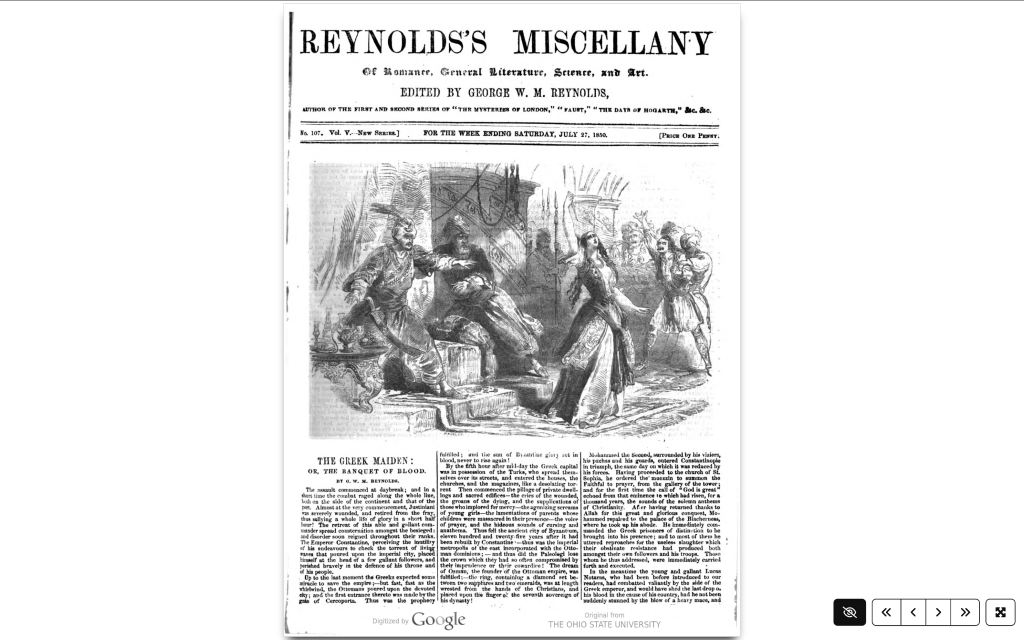
The sultan made a sign to the eunuchs; and in a moment the grand duke and his son were powerless in their hands, while Irene was dragged to the sofa where the tyrant was seated.
‘Monster – perfidious wretch ! is this the way in which thy promise is performed ?’ cried Lucas, vainly struggling with those who held him in their powerful grasp.
Mohammed took no notice of the young Greek, but approached the place where the beautiful Irene was seated. Torrents of tears deluged her cheeks – her hair was dishevelled – the fine linen which she wore was partially torn away from her bosom – and the tyrant feasted his eyes upon the maiden’s charms, which were enhanced by her deep affliction: for her eyes shone more brightly through her crystal tears, and the swell of her voluptuous bosom was rendered the more attractive by the convulsive sobs which agitated it.
Mohammed took her hand, and addressed a few words of consolation and golden promises to the forlorn maiden. She heeded them not: but suddenly her grief appeared to subside. A deadly pallor overspread her countenance – her eyes were fixed, and glared unnaturally – her bosom only heaved at long intervals. The sultan placed his arm around her waist – for he was intoxicated with passion and with wine . She turned her dark black eyes upon him – her lips moved convulsively – she seemed as she were under the fascinating influence of a serpent. Then a sudden impulse – the crisis of the sentiment which had abruptly inspired her with that unnatural calmness – urged her to accomplish the deed which she meditated. Starting from her seat – rudely repulsing the tyrant’s hand – she retreated a few paces from the sofa, drew a small thin dagger from her bosom, and plunged it into her heart. She sank upon the marble pavement, and expired without groan.
The sultan was like an infuriate lion when this dread catastrophe was accomplished. He drew his scimitar and was about to punish the father and brother of the self-immolated victim with his own hand. But the grand vizier held his imperial master back, and implored him to moderate his rage.
‘Do thou, then, avenge me !’ he exclaimed, throwing himself upon the sofa, and seizing the brimming goblet, which stood near.
The copious draughts of Cyprus wine which he swallowed only added fresh fuel to the fires of his indignation; and the grand vizier, in order to appease a rage which sometimes exceeded all natural limits, gave immediate instructions for the execution of the two noble Greeks. They were hurried away to the outer court of the palace, where the executioner awaited them. At that moment the grand duke recovered all his dignity and prepared to die, exclaiming ‘O God, thou art just and merciful !’ Lucas was first decapitated before his eyes: the gallant youth died exhorting his father to meet his fate in a manner worthy of a long life of glory. The duke then knelt in the midst of the guards; and in another instant his spirit had left this world, to join those of his magnanimous children. The heads of the father and son were carried into Mohammed’s presence, and placed, by the tyrant’s order, upon the table near him !
[1] The imperial family then ruling in Greece.
[2] Constantinople was also called Byzantium in those times, and hence Greeks were often called Byzantines.
[3] ‘Lord, have mercy !’

