
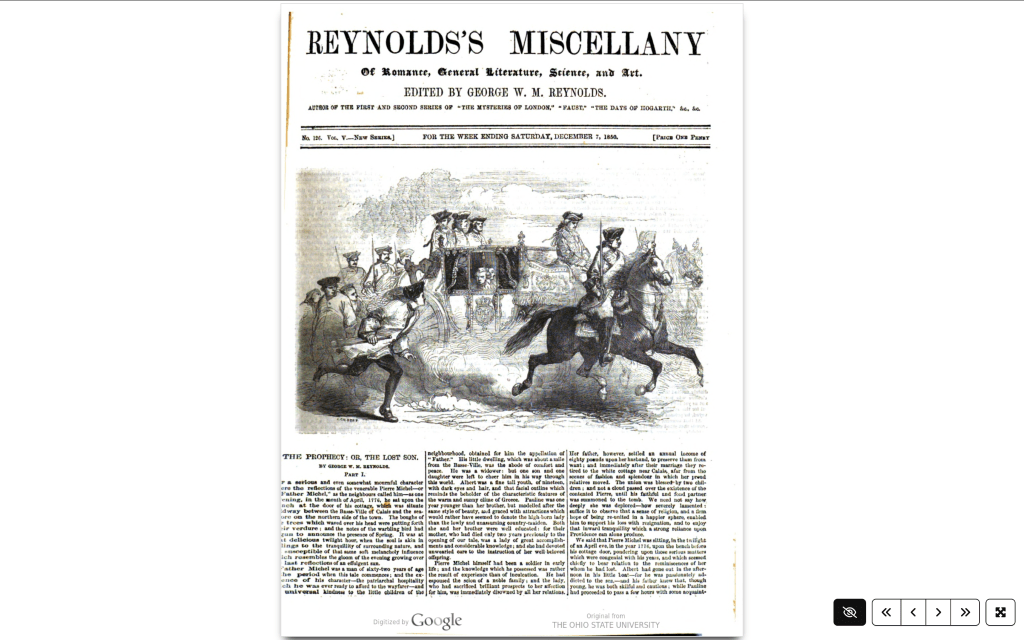
Part I
Of a serious and even somewhat mournful character were the reflections of the venerable Pierre Michel – or ‘Father Michel’ as the neighbours called him – as one evening, in the month of April, 1776, he sat upon the bench at the door of his cottage, which was situate midway between the Basse-Ville of Calais and the seashore on the northern side of the town. The boughs of the trees which waved over his head were putting forth their verdure; and the notes of the warbling bird had begun to announce the presence of Spring. It was at that delicious twilight hour, when the soul is akin in feelings to the tranquility of surrounding nature, and yet susceptible of that same soft melancholy influence which resembles the gloom of the evening growing over the last reflections of an effulgent sun.
Father Michel was a man of sixty-two years of age at the period when this tale commences; and the excellence of his character, the patriarchal hospitality which he was ever ready to afford to the wayfarer, and his universal kindness to the little children of the neighbourhood obtained for him the appellation of ‘Father’. His little dwelling, which was about a mile from the Basse-Ville, was the abode of comfort and peace. He was a widower: but one son and one daughter were left to cheer him in his way through this world. Albert was a fine tall youth, of nineteen, with dark eyes and hair, and that facial outline which reminds the beholder of the characteristic features of the warm and sunny clime of Greece. Pauline was one year younger than her brother, but modelled after the same style of beauty, and graced with attractions which would rather have seemed to denote the high-born lady than the lowly and unassuming country maiden. Both she and her brother were well educated: for their mother, who had died only two years previously to the opening of our tale, was a lady of great accomplishments and considerable knowledge: and she had devoted unwearied care to the instruction of her well-beloved offspring.
Pierre Michel himself had been a soldier in early life; and the knowledge which he possessed was rather the result of experience than of inculcation. He had espoused the scion of a noble family; and the lady who had sacrificed brilliant prospects to her affection for him was immediately disowned by all her relations. Her father, however, settled an annual income of eighty pounds upon her husband, to preserve them from want; and immediately after their marriage they retired to the white cottage near Calais, afar from the scene of fashion and splendour in which her proud relatives moved. The union was blessed by two children; and not a cloud passed over the existence of the contented Pierre, until his faithful and fond partner was summoned to the tomb. We need not say how deeply she was deplored – how severely lamented: suffice it to observe that a sense of religion, and a firm hope of being re-united in a happier sphere enabled him to support his loss with resignation, and to enjoy that inward tranquility which a strong reliance upon Providence can alone produce.
We said that Pierre Michel was sitting, in the twilight of an April even in the year 1776, upon the bench before his cottage door, pondering upon those serious matters which were congenial with his years, and which seemed chiefly to bear relation to the reminiscences of her whom he had lost. Albert had gone out in the afternoon in his little boat – for he was passionately addicted to the sea – and his father knew that, though young, he was both skilful and cautious; while Pauline had proceeded to pass a few hours with some acquaintances in the Basse-Ville. These friends consisted of a notary, his wife and son; and although the gloom of evening was rapidly increasing, Pierre did not feel uneasy, for he well knew that young Henri Alvmar would escort her home. M. Alvimar, senior, was reputed to be wealthy; Henri was his only son; and it was not with feelings of dissatisfaction that Father Pierre had beheld evident signs of attachment on the part of the young people.
But as the shades of night rapidly deepened, dark clouds gathered above – the wind began to whistle through the trees – and the whole aspect of the heavens announced the proximity of a fearful storm. Pauline reached home, escorted by the son of the notary, just as heavy drops of rain had chased her father into the cottage: but still Albert returned not. An hour passed away; and the storm broke with appalling violence. The roar of the sea commingled with the crash of the thunder and the moaning of the wind; and from time to time the whole sphere was illuminated for a few moments with the brilliancy of the lightning.
It was eleven o’clock on that fearful night when Pierre Michel and Henri Alvimar proceeded together to the coast, as Albert had not returned, and the fears of the father and sister had arisen to a pitch bordering on frenzy. Pauline wished to throw her cloak around her and accompany her father and Henri to the sea-shore; but the storm raged with a fury which would have rendered it highly imprudent and dangerous for a young female, tenderly nurtured, to expose herself to the cold wind and heavy rains. She accordingly consented to await their return; and towards the coast did the old man and his young companion proceed.
As they drew near the sand-hills which bound in that part the mighty bed wherein the ocean, lately so calm, was now raging, the sounds of many voices fell upon their ears – men calling out and giving orders, women screaming, and sailors vociferating words of encouragement and hope in their own particular technical phraseology. Then the flapping of sails and the rattling of cordage was heard; and when Father Michel and Henri reached the shore they found, as they had anticipated, that a ship had run aground, and that all human efforts were being made to save the crew. But how powerfully excited were Pierre’s feelings, how great his admiration, and how dread his alarm, when he was told, in answer to a few hurried inquiries, that three or four gallant young men had put off in a small boat to carry a rope to the ship, and that his own son was of the party. Indeed it was in compliance with Albert’s representations, and in his own boat, that this daring achievement was attempted.
‘Oh ! why was I not here in time to join him ?’ ejaculated Henri Alvimar, who entertained a strong friendship for the brother of his beautiful Pauline.
‘No !’ cried Father Michel impressively, ‘it would be too severe a blow, were those dreadful waves to engulf all our hopes at the same instant !’
Pierre scarcely knew what he had said: but Henri immediately fancied that an allusion to his attachment for Pauline was implied – although that attachment had not yet been formally revealed; – and, feeling grateful for the sort of acquiescence in his suit thus conveyed, he pressed the old man’s hand warmly.
At that moment a shout of welcome arose from the crowds that stood along the shore; and, that multitude suddenly giving way, Albert hastened forward bearing a female form in his arms. His father was instantly by his side.
‘Father,’ said Albert in a hurried tone, ‘an elderly gentleman – her father, perhaps – implored me to save this poor girl: she is insensible – she has fainted; – take charge of her – convey her home – you and Henri can carry her between you – while I retire and superintend the measures necessary to save the crew of yonder vessel.’
With these words he yielded his burden to those whom he addressed, and hurried back again to the strand.
No longer consulting those selfish fears for his child which had led him to the coast, Pierre immediately returned home with Henri, bearing between them the lifeless form of the young female whom Albert had brought from the distressed vessel in his boat. On their arrival at the cottage, the stranger was consigned to the care of Pauline, who placed her in bed, and administered the proper restoratives to call her back to life. In a short time the young lady – for such she evidently was – opened her eyes, and gazed in astonishment around her. A few words made her comprehend her safety; and she then inquired, in a hurried and anxious tone, after her father. Pauline was about to reply in the words of promise and hope, when the door opened, and an elderly gentleman rushed in, exclaiming ‘My child ! Josephine – my dearest child !’
We shall not dwell upon the affecting details of this meeting after the dread perils which they had just escaped; but, observing that through the gallantry of Albert Michel and his comrades in the dangerous enterprise the whole of the vessel’s crew was saved, we shall proceed to put the reader in possession of those few facts concerning the two strangers which they themselves communicated to the inmates of the cottage.
It appeared that the gentleman, whose name was Tascher, and his daughter — a beautiful girl of only thirteen years of age – had sailed from Martinique, a French island in the West Indies, some weeks previously, and that stress of weather had compelled the captain of the vessel to run for Liverpool. There she was detained for repairs; and M. Tascher, with his daughter, being anxious to proceed to France as soon as possible, hastened to Dover, where they embarked on board the hoy bound for Calais. The storm overtook the vessel at a distance of about five miles from Calais; the captain endeavoured to run for the harbour, but, overshooting the mark, got aground on the sands to the north of the pier. Albert, who had landed from his own excursion before the storm commenced, had observed the distress of the vessel in the distance, and remained on shore to watch its manoeuvres. He stayed until its dangerous predicament aroused his energies to action; and through the instrumentality of himself and a few other young men whom he persuaded to embark with him in his frail boat, the whole crew was saved.
M. Tascher, his daughter, and servants remained that night at the cottage: but in order to allow the young lady as much time to repose as possible, after the alarms and fatigues she had experienced, he determined not to commence his journey to Paris until the afternoon of the ensuing day. While he proceeded into Calais to make the necessary arrangements for a vehicle and horses to be ready at the time proposed, Pauline passed a few agreeable hours with her new friend.
The young lady possessed a most beautiful person, and an amiable disposition. She played on the harp, and sang with exquisite taste and feeling: – as she walked, her light form, modelled with the most exquisite symmetry, was the very personation of grace: – and the tones of her voice were the most melodious ever heard. She was passionately fond of flowers, and gladly assented to a proposal made by Pauline to visit the little garden adjoining the cottage. After having examined, with true botanic taste, the various products of the little enclosure, Mademoiselle Tascher was about to enter the house once more, when a gipsy woman approached the railings to demand charity.
‘I will have my fortune told !’ ejaculated the sprightly girl; and before Pauline could utter a word by way of remonstrance, she had already yielded her hand to the old sybil over the railings, saying at the same time, ‘Do you discover anything extraordinary in my destiny ?’
‘Yes – much of happiness, and some misery,’ was the reply, accompanied by a solemn shake of the head.
‘You take care not to commit yourself, my good woman,’ said the young lady. ‘I could utter the same prediction relative to any one, without much dread of it being falsified by the issue of events.’
‘You will pass through much misery, and will then be happy for period,’ continued the gipsy, not heeding these remarks; ‘your life will then once more verge into gloom and melancholy.’
‘Again, I cannot say that your prophecies are very sapient,’ observed Josephine.
‘Stay, then – upon your head be it !’ said the sybil solemnly. ‘You will be married soon – that union will not be happy – you will become a widow – you will marry again – and – and –’
‘And what ?’ demanded the young lady.
‘And you will become Queen of France !’ added the old woman.
The young lady withdrew her hand hastily from the gipsy’s grasp, and, uttering an exclamation of mingled joy, alarm, and surprise, turned towards Pauline to ascertain what impression the declaration had made upon her. Mademoiselle Michel smiled faintly – for she did not altogether approve of the freak; and her younger companion, having presented a silver coin to the old prophetess, retired, with her kind hostess, into the cottage.
At three o’clock that afternoon. M. Tascher and his daughter took leave of the family of Pierre Michel, but before they departed they manifested their gratitude towards the inmates of the cottage to the utmost of their power.
‘To you, gallant youth,’ said M. Tascher, addressing himself to Albert, ‘are my daughter and myself indebted for your lives. Accept this ring as a token of my esteem – my friendship – my gratitude. Nay – reject not my offer. It is not intended as a reward – for nothing could adequately remunerate valour like yours: it is only a pledge of permanent regard.’
‘On these conditions I accept the gift,’ said Albert; and he pressed with warmth the hand that placed a ring of immense value upon his finger.
‘Mademoiselle,’ said M. Tascher’s daughter to Pauline, on her side, ‘allow me to leave some token of my gratitude and esteem with you also. You know,’ she added, laughing, and in a whisper, ‘that I am to be Queen of France; and then you shall not be forgotten. In the meantime this chain’ – and she loosened one from her neck as she spoke – ‘must express my attachment towards you, and link our hearts for ever in the bonds of friendship.’
‘You also, then, must keep a token to remind you of me,’ said Pauline; and having left the room for a few moments, she returned with a bracelet, which she clasped around her new friend’s wrist, receiving the chain around her neck at the same time.
The word ‘farewell’ was then uttered on both sides; and M. Tascher departed with his daughter, leaving behind them at the humble cottage the most favourable impression upon all its inhabitants.
But these impressions varied considerably in their nature. Pierre Michel was pleased with the open-hearted disposition and honest frankness of M. Tascher; while Pauline felt herself deeply interested in the beautiful daughter of that gentleman. But on his part, Albert experienced an undefinable admiration of the young lady who had just taken her departure, which appeared to grow the more impassioned as he pondered upon her attractions. Every word she had uttered in his hearing during her short stay at the cottage –the softness of her hazel eye – the luxuriance of her dark brown hair – her sweet smile –and the graces of her sylph-like form, were all treasured in his memory. In a word, he was deeply enamoured of Mademoiselle Tascher; it was a love assuredly formed at first sight – but not the less sincere nor the less profound on that account; and from the moment she quitted the humble cottage with her father, to enter the vehicle that was to convey to Paris, Albert grew daily more and more melancholy.
And what was M. Tascher ? This question frequently intruded itself upon Albert’s mind – for he often reflected, in his visionary musings, upon the claims which he might assert in aspiring to the hand of her whom he loved, at some future period. M. Tascher had been but little communicative relative to himself or his circumstances. The few particulars before recorded, and a word which had dropped from his lips intimating that he was a widower, were all Albert knew concerning his history.
‘Still,’ thought the young man, ‘he is a gentleman – his manners and demeanour prove that: he is well educated – a fact evidenced by his conversation; and he is wealthy – for he travels with the circumstance and appendages, and in the style of a man of property. No – I may never hope for an alliance with his family – ‘twere presumption to indulge longer in the chimera !’
But the unhappy youth did indulge the chimera, and pursued it, and cherished it, and nursed it, and allowed his imagination to focus upon it, until there were moments when the bright vision seemed to be realized – when the object of his affection, grown to womanhood, accompanied him with smiles to the altar – and when all the fond aspiration of his youth were crowned with felicity and success. Alas ! it was indeed but a vision: weeks and months – and even years – rolled by, and no tiding were heard of M. Tascher or his daughter. Albert’s cheek grew deadly pale, – and his eyes unnaturally bright; — but, although frequent and urgent were the tender inquiries made by his father and sister relative to the cause of his altered appearance, he retained the secret in his own bosom.
Three years passed way – and Albert was now twenty-two. It was at this period that M. Alvimar, the old notary, died, leaving behind him considerable property, to which Henri, who was formally engaged to be married to Pauline, was the sole heir. As soon, however, as the funeral obsequies were performed, Henri was compelled to visit Paris, to receive certain sums of money which were due to him by virtue of his late father’s will. Pierre Michel, who had for a long time observed with pain and grief the deep melancholy which had taken possession of his son, and who vainly endeavoured to ascertain the cause, imagined that a change of scene might produce some beneficial effect; and he accordingly proposed that the two young men should proceed to Paris in each other’s society. Henri gladly accepted his young friend as a companion; and in the month of June, 1779, Albert Michel and Henri Alvimar set foot in Paris for the first time.
France at that time was a volcano, prepared to burst forth and startle the world with its convulsion. The extravagance, the dissipation, and the luxury of the French Court were at their height. There – amidst the crowds of gallantry and beauty that thronged the gilded saloons the Petit Trianon or Versailles – moved Marie Antoinette, the most charming and profligate queen in the world: – there were the voluptuary Maurepas, the profound and philosophic Turgot, the subtle Malesherbes, and the elegant de Vergennes. There was also the Duchess of Bourbon Penthievre, better known as the Princesse de Lamballe, who was subsequently put to death by the outraged population in that revolution on the brink of which the splendid court was hovering. All that was most refined of the chivalry, the talent, and the beauty of France, was concentrated round the throne of Louis XVI and his beauteous wife. It was the most brilliant epoch of the reign of the old régime; and probably pleasure was more sought after and high birth and elegance of manners the more valued because were already heard the distant murmurs of that dread explosion of popular fury which was so righteously and so gloriously to sweep away throne and altar – rank and riches.
Albert had undertaken the journey to Paris under the impression and with the earnest hope that he should encounter Mademoiselle Tascher. Thus, wherever he went – whatever public sights or exhibitions he visited, his mind constantly dwelt upon the one unforgotten idea –that of again beholding her whose image dwelt in his bosom. Henri Alvimar had particular business to attend to, and was usually occupied throughout the day with the matters that had called him to Paris; and thus Albert was left to wander about by himself, examining the countenance of every well-dressed female he saw either on foot or in her carriage, in the hope of meeting the one he most wished to see.
One afternoon Albert was sauntering in the vicinity of the Palais Royal, when he was suddenly aroused from a deep reverie into which he had fallen, by the rapid tramp of cavalry; and in another moment a detachment of the royal guards passed by. In the midst was the queen’s carriage: and her majesty waved her handkerchief from the window to the few worthless sycophants who welcomed her with their acclamations. The gorgeous vehicle passed: and three or four others containing the nobles and ladies of her majesty’s suite followed immediately behind. Albert watched the glittering cavalcade with mournful pleasure: for the charms of the young queen excited the generous compassion of his chivalrous soul, although his heart had been bestowed upon another. Just as the last carriage whirled past him, one of its occupants – a lady elegantly attired – leant forward for a moment; and Albert instantly recognised that countenance which was ever present in his memory.
He uttered an exclamation of surprise and joy; and without reflecting for a moment upon the indiscretion of which he was guilty, darted through the crowd after the carriage with the speed of a hunted deer. In a few moments – such was the haste with which he rushed onwards – he was alongside the vehicle; when a gentleman in a brilliant military uniform, and with a star upon his breast, who was sitting next to the idol of Albert’s heart, suddenly thrust his head from the window, and exclaimed in an abrupt manner ‘Move off, fellow !’
Albert stood paralysed in the midst of the street: the cavalcade whirled out of sight; and he was exposed to the rude jesting of the crowd that had witnessed his singular behaviour. But she, to gain a glimpse of whose countenance he had thus exposed himself to insult, had not seen him. He returned more melancholy than ever to the hotel where he and Henri were staying.
He felt convinced that it was not M. Tascher who had spoken to him abruptly from the window of the carriage. Could Mademoiselle Tascher have married ? and was it her husband who had ordered him to move off, and called him fellow ? At all events she was in the royal train, and even if still unwedded, was far above the reach of his presumptuous hopes.
Urged by that infatuation which invariably prompts the lover to seek to throw himself in the way of the object of his affection, even when an impassable gulf appears to exist between him and the chance of happiness, Albert wandered all day, and throughout a considerable portion of the night, about the precincts of the Tuileries, at which palace the royal family were then staying. Again he obtained a glimpse of the beloved one – just as, lounging back in an open barouche, she was whirled beneath the archway leading into the Place de Carrousel, on her way to the royal presence. There was a gentleman by her side – the same who had called him fellow; and this gentleman again beheld Albert gazing earnestly upon the lady seated by his side: but the lady saw not her admirer. The gentleman fixed a scowling glance upon the young man, from whose view the coach almost immediately afterwards disappeared.
‘This is a visit of ceremony, and will be brief,’ thought Albert: ‘I will wait here until they leave the palace.’
An hour and a half passed away, and Albert remained at his post. Presently the well-known barouche made its appearance; and this time its female occupant cast her eyes by accident upon our young hero. He instantly raised his hat: she recognized him, and uttered a cry of joy, while her cheeks were suddenly flushed with the glow of pleasure. Albert was about to advance nearer, when her companion, – the cross gentleman before noticed – ejaculated in a voice rendered tremulous with rage, ‘Back – back – fellow ! We do not know you – back !’
The lady cast a glance of mingled surprise and indignation at her companion, while Albert, embarrassed and discomfited, knew not in which way to take this strange conduct. But ere he had half made up his mind how to act, the barouche drove rapidly away; and the guard at the gates of the palace, who had witnessed the whole proceeding, commanded the young lover to retire. Abashed and confused, Albert did not even think of inquiring of the bystanders the name of the gentleman who accompanied the lady in the elegant barouche; but he returned to the hotel more wretched than before. On three or four different occasions, subsequent to the last-mentioned one, did Albert encounter her whom he had known as Mademoiselle Tascher. Each time was she accompanied by her rude male companion; and each time was he unable to obtain one moment’s conversation with her. She always bowed to him, with a kindness – it might almost be said with a sisterly warmth of manner; and her companion as invariably appeared to be indignant with her for bestowing that courtesy, as with Albert for receiving it. Neither on any of these occasions did Albert think of making such inquiries of the bystanders as should relieve him from his suspense relative to the condition of her whom he loved, and the nature of her connexion with the rude gentleman by whom he was invariably insulted.
Six weeks had thus passed away since the arrival of Henri Alvimar and Albert Michel in Paris; and at the expiration of that time the former had terminated the business which had led him thither. A day was accordingly fixed upon for their return, in spite of Albert’s anxiety to procrastinate the moment when he must quit Paris – perhaps forever: for Henri was anxious on his part to seek once more the spot inhabited by his much-loved Pauline. The day of departure dawned, and the hour arrived – but Albert was not true to his appointment. Henri proceeded to his friend’s chamber, where he found that Albert’s clothes were duly packed up, ready for the journey. An inquiry of the porter at the entrance of the hotel made him acquainted with the fact that Albert had sauntered out only half-an-hour previously, but not with the air of a person who was bent upon any particular business. Henri waited, and waited – and his friend did not return. The entire day passed – the morrow dawned, but with it came not young Michel. Henry now grew alarmed, and feared that some accident might have overtaken the absent one. He visited the morgue – or receptacle for dead bodies found in the river or elsewhere: he proceeded to the various hospitals; he called upon the magistrates; he made inquiries of the police – but nowhere could he obtain the slightest trace, nor hear the most remote tidings of him whom he sought. He passed a week in these fruitless researches; and then with a heavy heart he took his departure from Paris.
It were vain to attempt to describe the grief of Pierre Michel, or the anguish of Pauline, when Henri arrived at the cottage in the Basse-Ville, and communicated the extraordinary disappearance of Albert. For some time the old man was determined to proceed to Paris, and make personal inquiries after his dear son: but Henri overruled this desire, assuring him that no means which prudence or integrity could suggest, with a view to discover some trace of him or his fate, had been left unessayed. Conjecture as to the cause of that strange disappearance was vain: never was any mystery more unfathomable. The grief of the bereaved ones was therefore the more acute: for they declared that they could bear their loss with fortitude and resignation were they acquainted with the details; but that the horrible uncertainty which surrounded the circumstance only increased the sorrow it occasioned, by allowing free scope for the most dismal apprehensions. Sometimes imagination would picture to itself that the lost one had been foully murdered; – at other times, the idea would occur that he had committed suicide either in a moment of mental aberration, or through some cause which produced the melancholy that was unaccounted for to a fond father, an adoring sister, and a faithful friend.
But all conjecture was in vain: two years passed away, and no tidings were received of the lost youth. Pauline then allowed herself to be persuaded to reward Henri for his constancy and long tried affection, by bestowing her hand upon him: but the bridal was darkened by the thought that he who should have also been there, and whose presence would have completed the felicity of the day, was not in his place by his sister’s side: –the old man wept – and Pauline’s tears fell freely, – and Henri’s countenance was also moistened with the crystal drops of sorrow – as the priest pronounced that blessing which gave Pauline a fond husband, and Henri a loving and tender wife.
And what a valuable helpmate was Pauline ! Untutored in the various arts of polished life that so often disguise the true aspect of the heart, she cultivated a thousand of those nameless domestic graces which throw a halo of light and love wherever they are seen. Neat, simple, and beautiful was her ordinary attire: and on Sundays and holidays she was decorated with a simple ornament of jet and gold – a mimic dove, suspended from her neck, and dallying with every throb of her heart – a fit emblem of the purity and innocence that reigned within. The present given to her by her friend of the moment, Mademoiselle Tascher, was kept in her little work-box, and regarded only as a memento of promised and unrealised fellowship.
Months again passed away after the union of Henri and Pauline; and still there was no news of Albert. One evening Father Pierre was seated at his cottage door thinking of his lost son, and looking listlessly upwards to the beautiful serene sky. But the mind of the old man was not tranquil, nor at peace. Something within him told him that his son still lived, and urged him to seek after the lost but still dearly beloved youth. He then suddenly – and for the first time—blamed himself for his apathy in not seeking him whose strange disappearance he deplored. He was still at Calais – and his son had been lost in Paris – a distance of a hundred and sixty miles. Was it right that he – the father – should linger here ?
Urged by these reasonings, the old man started up, hastened to the dwelling of his son-n-law and daughter, and said ‘My children, to-morrow morning I depart for Paris. I shall not know peace – nor tranquility – nor rest, until I seek my lost Albert. Do not attempt to dissuade me from my progress –I am resolved.’
Neither Pauline nor Henri attempted to reason with the old man: and on the following morning he took his departure for the capital of France. On his arrival there, his first care was to institute all the inquiries which prudence could suggest: but the result was completely unsatisfactory. From the moment Albert had left his hotel, as before related, a few minutes previous to his contemplated departure with Henri, no trace of him remained. The old man, though weighed down by grief, still felt that he had performed his duty – that he had done all that human nature, in such circumstances, could devise or accomplish. Thus, after a fortnight’s search, he was almost inclined to renounce his fruitless errand, when a circumstance occurred to prevent his meditated return to his peaceful abode in the vicinity of Calais.
The evening before his intended departure he endeavoured to divert his mind from the contemplation of the dreadful bereavement he had sustained, by a walk in the delightful gardens of the Tuileries. Fatigued at length with his ramble, he threw himself upon a seat shaded by the graceful foliage of the trees which overshadowed it, and sank into a deep reverie. Suddenly a voice fell upon his ears – a voice so sweet and melodious, that he could not mistake it; for he knew it to be that of the young lady whom, with her father, his lost son Albert had rescued from shipwreck on the coast of Calais.
He started up and beheld a lady and gentleman walking past the place where he had been seated. She was young and beautiful – and he was some years older, with a fine military air and commanding demeanour. At that moment the expiring rays of the setting sun fell upon their countenances: and Father Pierre immediately recognised the features of her who was indebted to his son for her life. But the gentleman with whom she was walking was not her father: and yet she leant against his arm with all the ease and familiar reliance—if we may use such a phrase – of at least a near and dear relative. Perhaps he was her husband ? thought Father Pierre: at all events she would doubtless be pleased to meet with him who had accorded her and her sire the rites of hospitality in the midst of that memorable night of storm and shipwreck. He accosted her, made a low bow, and was about to address her, when she instantly recognized him, grasped his hand with warmth, and saluted him by his name. She then made kind and anxious inquiries after his family – adding ‘I am sadly to blame, M. Michel, for my neglect – my unpardonable ingratitude, in not writing, if it were only one word, to my dear friend Pauline; but since my arrival in Paris, I have not had a moment to call my own.’
She sighed as she uttered these words, as if the real reason of her silence were of a more grave nature than the apology stated.
‘Madam,’ said Father Pierre, ‘I thank you for your kindness and condescension: but I was foolish to suppose that that either myself or family could dwell in your memory, or that of your father. I have seen enough of your gay city of Paris to be fully aware that its pleasures and enjoyments are of no common order, and that the fashionable world is not the sphere in which sweet sympathies can be supposed to dwell for any length of time. Relative to my family, madam, my answers are soon given. My daughter is married to the young man whom you saw at our humble abode, and is happy in that union. My son –’
He stopped short, and the tears poured in a torrent from his eyes.
‘Your son !’ echoed the lady: ‘can any evil have happened to your son ?’
‘He has disappeared, madam –most mysteriously disappeared,’ answered the father, sobbing as he spoke.
‘Disappeared – impossible !’ cried his fair querist.
‘He visited Paris, madam,’ continued the old man, ‘two years and a half ago – and he never returned home. It is to seek him that I am now in this city, from which I intend to depart to-morrow morning, my researches having all proved unavailing.’
‘Disappeared !’ again ejaculated the lady, who had received this announcement with the most unfeigned surprise: ‘disappeared, do you say ? and about that time – about two and a half years ago ? Speak – M. Michel – speak !’
‘It is as you say, madam,’ returned the old man.
‘Ah, now I comprehend it all !’ cried the lady, a flush of crimson suddenly over-spreading her countenance: then turning towards her companion she said in a tone of bitter irony, but still of deep emotion, ‘Viscount, you can probably acquaint this old man – this unhappy father — with the place in which he may find his son !’
She disengaged her arm from that of her companion as she spoke, and cast upon him a glance which seemed to penetrate his soul – for he quailed beneath it.
‘My son – my son !’ cried the old man, joining his hands together in an appealing manner: ‘what know you, sir, of my son ? Oh, tell me, – keep me not in suspense – what know you of my son ?’
‘Your son – your son –’ stammered the Viscount: for of this rank the individual really was.
‘My son – my dear, my only son, Albert Michel !’ added the old man, wild with mingled grief, suspense, and hope.
‘Albert Michel !’ muttered the viscount between his teeth, while he compressed his lips together with rage: ‘do you ask me about Albert Michel ?’ – then, after moment’s pause, he added, ‘Old man, where do you reside ?’
Father Michel named the inn at which he was staying.
‘To-morrow, by mid-day, you shall hear from me !’ said the Viscount in a low but decided tone; and taking the lady’s hand, he led her hastily away from the spot where this conversation had taken place.
Father Michel fell upon the seat, exclaiming ‘Thank God ! I shall again behold my son ! He is not dead – he will be restored to me !’
He sank into a reverie as delicious as that from which he had originally been wakened was painful; and it was not until a sentinel warned him that the gardens were about to close that he recollected where he was, or thought of the necessity of retiring.
That night he scarcely slept a wink; and on the following morning he was up at an early hour. How heavily hung the time upon his hands until the clock struck twelve: he thought the sun would never gain its meridian point. At length the wished-for moment came: and now his heart beat with all the varied emotions produced by hope and suspense. Five minutes elapsed – and a footstep ascended the stairs leading towards his room. Father Pierre hurried to the door: and an elderly man, dressed in deep black, entered the apartment.
‘Your name is –’ began the stranger in a mild and pleasing tone.
‘Pierre Michel,’ immediately answered the anxious father.
‘I thought I was not mistaken,’ said the other. ‘I presume you are acquainted with the object of my visit ?’
‘To lead me to my son –to tell me news of him whom I have sought with so much perseverance !’ exclaimed Michel.
‘Then follow me,’ said the stranger; and he led the way into the street, where a chaise was waiting.
Pierre Michel and his guide entered the vehicle, which immediately drove away at a rapid rate through the streets leading to the eastern extremity of Paris.
Part II
In order to pursue the thread of this narrative properly, it will now be necessary to return to Henri Alvimar and his beautiful wife Pauline. During the absence of the old man in Paris, they looked anxiously each day for the arrival of the mail with the letters from Paris; and on two or three occasions their anxiety was relieved by the receipt of news from him in whose safety they felt so deep an interest. At length all tidings ceased – and he returned not home. Day after day passed – weeks flew away – and he neither came nor wrote. Henri could not help associating this mysterious disappearance of the father with that of the son; and he resolved to devote himself to penetrate the mystery which, by snatching away two members of a family, had left the others in a state of such dreadful suspense. Pauline, whose grief knew no bounds, implored her husband to allow her to accompany him in the meditated search after those whom she so tenderly loved; and this desire was complied with. They repaired to Paris; and having installed themselves in a comfortable but secluded lodging, entered in their turn upon those inquiries and researches in the success of which they seemed to have embarked all their hopes of happiness for the remainder off their years.
Were we to dwell upon the numerous measures adopted by Henri Alvimar to obtain some clue to the brother or the father of his beloved wife, we should far exceed our limits in this episode. We must therefore sum up in one word the result of several years of unwearied research and persevering inquiry: we must in one sentence dispose of the incidents of a considerable section of human life: – and in the most concise manner possible, we must record the simple fact that seven years passed away since the moment when Henri and Pauline arrived in Paris, and that at the expiration of this interval they appeared to be no nearer to their object than on the day when they first set foot in Paris together.
During all this long sojourn in the metropolis of France, Pauline had led a most retired and secluded life – seldom quitting her own domestic hearth, and though not surrendering herself to a wild and frantic grief, still imbued with a profound melancholy, which her devoted husband’s tenderness alone softened down, and at times arrested. Henri had at first been much away from home, prosecuting his inquiries with a perseverance and energy which deserved success: but he gradually relaxed from this ardent application to the one grand object : – not that he grew cold or callous; but because he was compelled at length to admit the utter inefficiency of his means to penetrate a mystery which seemed as insurmountable as that of futurity itself. He also saw the necessity of devoting more of his time to Pauline; and thus this fond couple knew no wish for society, but seemed happiest when compelled to trust only to each other for consolation or pastime.
They formed no acquaintances, frequented no places of amusement, and abstained from appearing in public as much as possible. The mysterious event into the secret of which they could not penetrate had imbued their minds with a certain superstitious dread of evil when they were separated; and this sentiment was also a bond tending to link them almost inseparably together.
It was probably this species of superstitious feeling – a sentiment for which they often blamed themselves, but of which they could not divest their minds – that induced Henri to propose a new plan to the solution of the mystery which developed the fates of Pierre and Albert Michel. At the epoch of which we are writing – and which, the reader will remember, was that when France stood upon the eve of her first revolution – the name of Mademoiselle Lenormand began to be famous in Paris. This remarkable female – who was at that period only seventeen or eighteen years of age – had just commenced that process of soothsaying which she since prosecuted with such unrivalled success.
During her youth, several remarkable prophecies which met with an exact fulfilment attracted the attention of the Parisians towards her; and the moment she publicly announced her determination to devote to the general benefit a gift which she deemed to have been conferred upon her by heaven, her residence was crowded with the fashion, the nobility, the wealth, and the learning of Paris. Implicit faith was placed in her predictions; and as she was a woman of remarkable penetration, she was often enabled to deduce correct opinions from the combination of certain antecedent circumstances.
Thus, by making herself previously acquainted with the deeds and characters of those who consulted her, she was emboldened to predict of the future according to the past; and as men, as well as nations, prepare their own destinies by their own conduct and passions, it was not very difficult for a woman of profound observation, infinite tact, and acute judgement, to foresee the paths into which the nature of particular individuals were certain to conduct their footsteps. She was, moreover, an excellent politician, well versed in the history of all nations, and skilled in reading the depths of the human mind beneath the outward polish, hypocritical gloss, or conventional bearing which those who visited her were accustomed to assume.
Then, again, she had another circumstance in her favour: the mind of the individual on whom her predictions made an impression like that of a religious awe subsequently viewed everything through the mirror of the new light opened to it, and shaped its thoughts according to the destiny to which it believed itself to be tending. These thoughts modelled the actions of the individual in their turn; and thus the very presages which issued from the lips of the sorceress became in numerous instances the very springs of action that conducted men and women onwards to the goal to which it was predicted that they should arrive.
The more gloomy became the face of political affairs, the more confidently did Mademoiselle Lenormand utter her prophecies concerning the coming revolution – the destruction of the existing organization of society – the ruin of altars, and the horror of the guillotine. She knew that the day of popular supremacy would be that of retribution; and that the proud oligarchy which had so long trampled upon the most sacred rights and holy privileges of the people would be at once the objects of vengeance and fury. She accordingly prophesied of streams of blood – and crowded prisons – and exiled nobles—and slaughtered priests – ruined thrones and dismantled churches – and the levelling of all ancient superstitions along with all ancient abuses. In a short time she was looked on as a Pythoness,[1] on whose tongue truth alone might dwell; and wealth poured in upon her from all sides.
Such was the person whom Henri felt inclined to consult; and Pauline immediately assented to the proposition. It will be recollected that in her childhood, at the little cottage near Calais, she had not approved of the freak of the volatile Josephine Tascher, who allowed her fortune to be old to her by an old gipsy: but she was now so far altered by the superstitious influence exercised upon her mind by the mysterious pre-sentiment of a family danger which she constantly entertained that she felt something akin to her own feelings in the religious awe which accompanied the consultation of Mademoiselle Lenormand. The proposal was therefore no sooner made by her husband than she conjured him to carry it into execution; and that same evening did they proceed to the dwelling of the sorceress.
They were admitted into an ante-room by an old woman, whose back was so bent with the weight of years that they could scarcely obtain a glimpse of her countenance. She did not, however, fail to scrutinise the visitors from beneath her shaggy eye-brows; and to the features of Pauline her glances were upraised for some moments. The ante-room was only dimly lighted; and upon shelves around were placed skulls, stuffed alligators, lizards, snakes, and glass jars containing reptiles of all kinds, preserved in spirits of wine. The walls were hung with black, and a coffin stood upon a table in the middle. The faint lustre of a silver lamp did little more than render this horrible spectacle just dimly visible to the eyes; and the old hag with her crooked back and her sable garments seemed the presiding genius of one of the chambers of the Palace of Death. Pauline felt alarmed, and clung to her husband’s arm for support: but he implored her in a whisper to take courage, and nerve herself to arrive at the issue of the adventure.
Meantime the old hag left the visitors in the ante-chamber of horrors, and glided into an adjoining apartment, the door of which, also covered with black cloth, moved noiselessly upon its hinges. The very silence of that place seemed to be that of the tomb; and Pauline and Henri, apparently under the influence of some deep but undefinable awe, spoke to each other in the lowest whispers. At length the old woman returned with a message that Mademoiselle Lenormand was at present engaged with the Viscountess of Beauharnais, but that she would receive the visitors in a few minutes. This interval was passed in silence; and at length a silver bell tinkled behind the black drapery. The old hag now beckoned Henri and Pauline to follow her into the next apartment; and in another moment they found themselves in the presence of the sorceress.
This second chamber was hung around with sable drapery, like the first. At the further end stood a table, covered with a cloth of the same sombre hue, and upon which globes, old black-letter volumes, a small orrery, an hour-glass, a large sheet of parchment covered with hieroglyphics, a basin full of eggs, and a small coffee-pot boiling over a spirit-lamp, were placed. The room was as dimly lighted as the other: but there were no symbols of death piled around. Upon a stage behind the table stood Mademoiselle Lenormand, dressed in deep black, wearing a huge sable turban upon her head, and with her long, jetty, luxuriant hair flowing wildly over her naked shoulders. Her commanding figure was drawn up to its full height; and her large dark eyes beamed with unnatural lustre. In her right hand she waved a long black wand; and her left held a small volume open, to which she from time to time referred.
Two chairs were placed by the old hag, who served as attendant, near the table; and she then withdrew. Henri and Pauline seated themselves, upon a sign from the sorceress; and ten minutes them passed without a word being spoken, – Mademoiselle Lenormand continued to wave her hand and refer to her book, upon the raised dais. At length she looked earnestly towards the visitors, and exclaimed – ‘Henri Alvimar, what would’st thou with me ? Pauline, speak –fear not !’
The two visitors were rendered speechless by hearing themselves thus addressed by a person whom they had never seen before: and they made no reply.
‘Wherefore are ye silent ?’ continued the sorceress.
‘Are ye surprised that I should name ye by your names ? what faith would ye accord to my predictions were I unable to penetrate into all your family secrets – to tell ye all that has already happened to you – and thus the more appropriately connect the chain of the past with that of the future ? And first let me speak of the pledges of friendship give to ratify vows never redeemed – a chain to the neck of Pauline Michel – a bracelet to the arm of Josephine Tascher – a ring on the finger of the lost Albert ?’
‘True –O God ! It is all true !’murmured Pauline. ‘But Albert – oh ! what of Albert ? and my father – my dear father ?’
‘They are alive !’ solemnly answered the sorceress.
‘Alive ! then heaven be thanked !’ ejaculated Pauline. ‘But tell me more – say, shall I see them again ? – will they ever be restored to me ? – are they in health, in happiness ? – and why, Oh ! why this long separation – this fearful and mysterious disappearance ?’
‘The hand of Providence will, by his wise means, reassure you to each other,’ said Mademoiselle Lenormand. ‘Hark ! hear ye not the din of the artillery, and the sharp crack of the musket ? Falls not the roll of the drum or war on your ear ? Is your soul unmoved by the braying of those war-trumpets ? Hark once more ! the battering-ram is striking the wall: there – now again – there – there, with each stroke the huge stones shake and totter. And now the conflict begins – it is hand to hand, and foot to foot: on, on go the assailants, like a whirlwind ! ’Tis done; – see yon crowd of trembling and pallid beings – amongst them are faces that are familiar to you – there, there is your father, and there also is your brother !’
The sorceress had commenced this harangue in a low tone, which imitated the distant murmurs of a multitude: then, as she seemed to witness each progressive incident to which she alluded, her voice grew louder – and her utterance more rapid: her eyes rolled, and she waved her wand more and more rapidly, pacing the dais at the same time with steps increasing in speed, in unison with the exaltation of her voice; until at length she strode backwards and forwards like a tigress in her den, while her manner grew wild, her eyes dilated with apparent frenzy, her bosom heaved convulsively, and her naked white arms waved over her head, brandishing the book and the wand, and giving her the air of an inspired druidess, or of Cassandra raving.
Henri and Pauline gazed and listened with breathless attention; and when the sorceress concluded her remarkable address, accompanying each sentence with the befitting gesticulation, and pointing towards the farther end of the room, as she exclaimed ‘There is your father ! and there is also your brother !’ – the startled Pauline turned round to see if they were not really there. But the eyes of the sorceress appeared to be glaring upon vacancy; and Pauline, whose nerves were worked up to the highest pitch, experienced a sudden reaction which threw her fainting into her husband’s arms.
Mademoiselle Lenormand instantly flung aside her wand and her book, and hurried forward to administer aid to Madame Alvimar. Taking a bottle of some powerful essence from the table, she applied it to Pauline’s nostrils, and immediate signs of life were the result. In a few moments Pauline was perfecting restored; and the sorceress then seated herself at the table covered with the implements of her art.
She took an egg and broke it into a wine glass; she then cut the yolk with a penknife, and watched the yellow commingling with the white for some minutes. She next filled a large cup with coffee from the silver urn over the spirit-lamp; and then she poured the reeking liquid into a flat silver dish. There she watched the motion of the bubbles, the course which the current took in turning round and round, and the shape of the white foam upon the surface.
‘Pauline,’ she exclaimed, when these preparations were complete, ‘in what month were you born ?’
The question was answered: and the sorceress then asked ‘What is your age ? what colour do you prefer in regard to dress ? What is your favourite animal ? To which animal do you have the greatest antipathy ? Which flower do you love most ?’
To all these inquiries Pauline replied in a trembling tone, and when she had answered them, she said ‘But if you are about to tell me my future fate, I would rather not listen to the narrative. If it be happy, I shall be restless until the period of felicity arrive: if miserable, I should be anxious to quit this world in time to avoid the inauspicious epoch.’
Mademoiselle Lenormand seemed annoyed by this observation – for she pushed the glass containing the egg away from her with impatience.
‘But,’ continued Pauline, after a moment’s pause and willing to efface any cause of displeasure, ‘should your art extend to the power of giving me some information more precise –’
‘Concerning your father and brother,’ hastily ejaculated the sorceress, ‘no – no ! I have said enough: that inspiration has left me. Have you no other friend – none in whom you feel the slightest interest – concerning whose fortunes you may be anxious to make inquiry ?’
‘Ah !’ said Pauline, a sudden reminiscence flashing through her mind, ‘you spoke ere now of the one vowed eternal friendship to me in our days of childhood. I feel an interest in Mademoiselle Josephine Tascher – a curiosity –’
‘That interest and that curiosity shall be satisfied,’ said Mademoiselle Lenormand. ‘You shall see the lady of whom you speak, and be thus convinced that she is happy, and in health.’
Mademoiselle Lenormand directed Pauline and her husband to withdraw to the further end of the apartment, so as to be as distant as possible from the extremity where the table and dais stood. They obeyed her commands, their breasts being the prey of the most lively suspense, and fraught with the most profound awe. Vainly did Henri struggle against the superstitious feeling which was gradually gaining a more complete ascendancy over him. Meantime the sorceress ascended the dais, waving her wand mysteriously, and muttering words whose import the anxious spectators could not understand. Suddenly a portion of the black drapery overhanging the stage gave way, and revealed what appeared to be a small chamber, about twelve feet square, and yet more nearly resembling a picture seen in a mirror. Upon the sofa in that mysterious chamber was seated a lady – elegantly attired, with a coronet upon her brow. She raised her head the moment the drapery fell; and Pauline immediately recognised the countenance of that same Josephine from whom she had received the chain in pledge of friendship. And upon that lady’s wrist was the bracelet which had been given in exchange.
The vision – if such it were – lasted only for a moment; the drapery was as suddenly expanded again over that bright and luminous picture – or reality (whichever it might have been); – and Pauline, uttering a scream of terror threw herself into her husband’s arms.
‘Depart – depart !’ ejaculated Mademoiselle Lenormand; ‘my art can do no more !’
Henri threw his purse upon the seat which he had just abandoned, for he knew that the sorceress accepted payment for her services; and with his own mind a prey to the most conflicting opinions, he bore his wife from the abode of mystery and wonder.
When Alvimar and his wife sate down next day coolly and quietly to discuss the events of the preceding evening, their marvel and bewilderment increased only with conjecture. Henri possessed a strong mind; and he was unwilling to admit the powers of the sorceress to their full extent, but still there was no room for placing faith in part and rejecting the remainder. She certainly was acquainted with them and their history, and she had declared that the venerable Pierre and Albert were still alive. This statement he was inclined to believe, because she was evidently well informed with regard to the past events of the Michel family: – but how reconcile with all preconceived opinions the affair of the apparition ? To convey information in respect to the life or death of persons was within the attributes of mortal power: but to summon to a certain spot the effigy – all animated, warm and smiling – of a being dwelling elsewhere, at the option of any particular individual, was a proceeding calculated to disturb even those minds which were prepared, by previous education or experience, to place reliance upon any wonders, however superstitious – however unnatural.
As is usual in such cases, all the discussion and conjecture in the world led to no satisfactory result: at one moment both Henri and Pauline were inclined to believe in the association of the sorceress with invisible powers; while at another they looked on the whole proceeding as a well-combined fraud and imposture. Time, however, wore on; and the dangerous aspect of political affairs would have driven Alvimar and his wife away from Paris back to their abode in the Basse-Ville of Calais, had not a secret and indestructible hope that Mademoiselle Lenormand’s prophecy would be in some way or other fulfilled retained them in a city which was about to be the scene of the most extraordinary popular ebullition which the world has ever beheld. The measure of regnal iniquity had arrived at its full: the people could no longer tolerate the state of bondage in which they lived; – and the Revolution commenced with the storming of the Bastille.
It was upon that eventful day when this terrible fortress was attacked by the Parisians that Henri Alvimar was returning from the Faubourg Saint Antoine, whither he had been upon business of some importance. On that day the adamantine bars of the most formidable prison in the world were rent by the popular will, as Samson snapped asunder the cords of the Phoenicians; – the secrets of that dread castle were displayed; – the dark dungeon of slavery was illuminated by the torch of popular vengeance ! The words of the prophetess were fulfilled to the letter: the drumbeat – the trumpet brayed – and the cannon roared; – the royal troops fought like demons against the incensed people; – but the citizens prevailed then, as they have prevailed since in France, and as they will prevail ever, because they the true courage inspired by the noblest feelings – feelings of honour, of patriotism, and of glory, which seem, alas !, to be unknown elsewhere.
Yes – the words of Mademoiselle Lenormand were fulfilled. Alvimar, entangled amidst the crowds pressing onwards to aid in the attack on the Bastille, and aware that all endeavour to extricate himself would be useless, became resigned to the necessity which forced him to witness, if not to take part in, the glorious achievement; and he was carried on towards the principal gate, just at the moment when the popular banner waved on the wall – a symbol of Freedom’s victory. The gate was forced; and in a short time the captives obtained their release. Some of them rushed into the streets with the looks of madmen, anxious once more to gaze upon the houses, the people, and the vehicles – and yet doubting whether they were not in a state of somnambulism and dream, in their own dreary cells; –others came forward timidly to the gate, and then drew back, alarmed at the appearance of a great crowd; — here one danced for joy – there another seated himself upon a stone and wept: – never was seen such a strange display of various feeling and emotions, all produced by a common cause.
Captives of twenty, thirty, forty years – aye, even of half a century – and prisoners of only a year or a few days – came forth from their dread abode, scarcely daring to believe that they were really free. But suddenly amidst the crowd of captive two men have recognised each other – an old one with a long white beard covering his breast, and a younger man with a black beard curling short upon his chin; – they have uttered cries of surprise and joy – the people have formed a circle around them – they exclaim, the one `My father !’ the other `My son !’ – and they have fallen into each other’s arms. And then, almost at the same moment, another individual darts like lightning from the ranks of the spectators of this affecting scene, and claims a share in the old man’s embraces, and in the younger one’s joy. Thus was it that Henri Alvimar met Pierre Michel and Albert once more; – thus was it that the father and son suddenly found that they had languished for years in the same prison house, without knowing that one was near the other; –and thus, in a word, was it that the prophecy of the sorceress was fulfilled !
Oh ! who shall describe the joy and delight which prevailed in the dwelling where the entire family soon united once more ? Pauline ran from father to brother to embrace them again and again; and Henri was never wearied of demonstrating his affection towards the old man and his sincere friendship for his brother-in-law. But at length the fervour of awakened and renewed passions became mellowed down to tranquil happiness and ineffable contentment: and then commenced questions and explanations of all sides.
It appeared that on the day when Albert was to have returned with Henri to Calais, he made the necessary preparations for his departure, and finding that he had a leisure half-hour still to dispose of, walked out to take a parting survey to the Tuileries. While he was on his way thither, he was stopped by two men dressed in plain clothes, who inquired if his name were Albert Michel, and whether he had not accosted a lady on several occasions in her barouche. He immediately replied in the affirmative: they stated that the lady in question desired an interview with him, and that they were to conduct him to the spot where she was waiting for him. He suffered himself to be persuaded to step into a carriage, although he at the moment could not help entertaining a distant suspicion that some treachery was intended; and in this manner was he conveyed to the Bastille. There he had languished until the day of its destruction in the year 1789 – unaware that his father some time afterwards became an inmate of the same horrible prison –ignorant of the crime for which he was incarcerated, unless indeed it were connected with the lady whom he had known as Mademoiselle Tascher – and left in a most terrible state of incertitude with respect tohis family and his own future fate.
Part III
The narrative of Father Michel recorded the preliminary circumstances which led to his own incarceration and with which it will be remembered that Alvimar and Pauline were hitherto unacquainted. The old man’s history corroborated the idea that some motive connected with M. Tascher’s daughter Josephine had led to the confinement of father and son in the most horrible of prisons: but in what way they could have committed an offence calculated to draw down upon them such a dread penalty, they were at a loss to determine. The years of their captivity had been passed in privation and misery, mental and bodily: the vigour of Albert’s mind was destroyed – the strength of his constitution undermined – and the generosity of his disposition perverted. His cheek wore the mark of disease – and his brows lowered with hatred upon mankind. To his family, it was true, he was affectionate and tender: but when he spoke of the world, his lips compressed, his hand was clenched, and his forehead darkened. His heart was, however, the same towards one being –unchanged in his love for her – unaltered in respect to that maddening passion which had devoured him in secret, and preyed upon his vitals ! He breathed not a word relative to the existence of that undying flame: it was his secret – he conceived that he had suffered on account of it – and again he determined to recommence his search after the object of his love. He determined to throw himself at her feet and implore her hand, if she were still unwedded; – or to seek an explanation of the past, and then take leave of her for ever, if her heart were no longer at her disposal.
The old man had suffered much less by his long incarceration than his son. The feelings of old men are not so acute, nor so violent as those of the young and produce less effect upon the physical constitution. He was now verging towards four-score years: but he was still hale and hearty; and restoration to his family speedily wiped away from his mind the most poignant impressions created by his painful captivity. All were unanimously of the opinion that the late misfortunes had arisen from secret causes connected with those whom Albert had rescued from the waves, at the risk of his life, and who had received the hospitality of the cottage in the Basse-Ville; and all – save Albert – expressed their conviction that the wisest and most prudent course was to return to that tranquil home – afar from a metropolis which teemed with so many perils. Albert declared his intention of remaining in Paris to take part in the great struggle which he saw approaching: in vain did his father command, Henri remonstrate, and Pauline implore; – the young man was unmoved, and pertinaciously refused to sacrifice his own wishes to the will of his friends. It was therefore determined that the entire family should prolong its sojourn in Paris; and a convenient house was taken in the neighborhood of the Boulevard du Temple.
Although many incidents be crowded into this narrative, it is necessarily hurried and condensed; and with the rapidity of the change of the magic lantern, or the shifting of the scenes on the stage, do we skip from scene to scene, and from date to date. We must now again solicit our readers to suppose an interval of four years to have passed away; and in that time the contemplated changes have all been effected. The righteous wrath of the people, so long enslaved and trampled upon, had commenced its sway and was still progressing; the awful retribution, so insanely provoked, was sweeping onward in its giant course. The house of the Bourbons had been plunged into mourning – a king and a queen had perished upon the scaffold – and the Reign of Terror had succeeded the regime of monarchy. Father Michel’s family was still in Paris – Albert bent constantly on his vain and fruitless search for Josephine; and Henri and his wife being contented and happy in each other’s society.
One morning Albert was wandering along that quay of the Seine which is overlooked by the terrace of the Tuileries, when the condemned cart approached, on its way to the guillotine in the Place de la Concorde close by. Urged by a natural feeling of curiosity, Albert stood aside to mark the fatal vehicle proceed on its melancholy journey: but his interest was speedily engaged in the freight which the cart bore – for amongst the condemned ones he recognised, to his unfeigned wonder, the stern-looking gentleman who had accompanied M. Tascher’s daughter Josephine on former occasions and who had uttered those memorable words `Back, fellow – back !’ He was also the same, be it remembered, who was with that lady on the day when Pierre Michel encountered her in the gardens of the palace, and when the restoration of Albert was promised but as the snare to entrap the old man into captivity.
Albert followed the cart, but could not catch the prisoner’s look. The unhappy man never raised his eyes off the missal which he held in his hand: and when he suffered himself to be bound to the fatal plank, he glanced neither to the right nor to the left. In a few moments, after that portion of the ceremony, he had ceased to exist.
Albert inquired the name of the individual who had just suffered.
‘Alexander, Viscount de Beauharnais,’ was the answer.
‘Was he married ?’ asked Albert.
‘Yes – and he has left a widow and two children. The Viscountess is in the prison of the Magdelonettes, and is most probably reserved for the same fate.’
‘Do you know the maiden name of his wife ?’ demanded albert of his informant.
‘Mademoiselle Tascher,’ was the reply.
‘I thought as much – I thought as much !’ murmured Albert to himself: and dashing through the crowd, he hurried onward as quickly as possible, to the hospital or prison of the Magdelonettes.
He inquired of the turnkey if the Viscountess de Beauharnais was confined there, and learnt that she was. He essayed to obtain access to her – but failed. Day after day, however, did he walk beneath the windows, and endeavoured to obtain a glimpse of her countenance through the dark bars of iron which fenced them. But no – his hopes remained unsatisfied, although his perseverance continued the same. At length the constancy of his visits to the vicinity of the prison became noticed by the gaolers; and information was sent to the Committee of Public Safety. In those times the most trifling act was sufficient to create alarms: and albert’s pertinacity in endeavouring to obtain a means of communications with the royalists was sufficient to effect not only his own ruin, but that of all his family. One night the house in which they dwelt was surrounded and entered by soldiers of the Republic, and all were arrested. Pauline was immediately despatched to the hospital of the Magdelonettes, that being the receptacle for female prisoners in those times; while her father, husband and brother were consigned to the Luxemburg. Thus in one moment did misfortune again enter upon the domestic hearth of that unfortunate family, and sweep away all those hopes of peace and happiness in which the inmates had indulged.
Albert had informed his relatives that Viscount de Beauharnais had perished on the scaffold – that his wife was the daughter of M. Tascher – and that she was a prisoner in the Magdelonettes. Pauline was therefore prepared to meet her on her arrival at that place of detention; and the moment she entered the room to which female prisoners were consigned, she recognized the Viscountess amongst four or five ladies who were also captives there. Madame de Beauharnais threw herself into the arms of Madame Alvimar; and the two friends, thus so singularly united again, wept copiously upon each other’s bosom. When the first effusion of feeling was somewhat passed, Pauline narrated all that had occurred since the day when they parted upwards of fifteen or sixteen years previously, at the white cottage in the Basse-Ville; and the tears of the kind-hearted Josephine fell fast when she heard all that the family of the Michels had endured.
‘It is now my turn to give you some explanations,’ said she, ‘which will fill up some of the gaps in your narrative, and account for much which as yet remains dark and mysterious to you. My name, as you well known was Josephine Rose Tascher de la Pagerie; and I was born at St Pierre on the island of Martinique. My mother died when I was young; and I accompanied my father to France in 1776, my hand having been previously betrothed to Viscount Alexander de Beauharnais.
‘It was upon the occasion of my arrival in France that I had the pleasure to form your acquaintance, and should have been overjoyed to cultivate your friendship, as promised, but for the reasons which I will now explain. I found my husband – for you must know that I had no time allowed to obtain an insight into his character during a period of courtship – a man of stern but honourable character, attached to all the prejudices of rank and birth, and so jealous of his fair fame that he considered every one he met inclined to filch him of it, or injure it in some shape or way. Thus he was the most miserable husband on the face of the earth – and he would have rendered me the most wretched wife, had not the natural volatility of my character prevented me from taking his behaviour on all occasions in a serios light. He was the most jealous man in existence; – alas ! he is now gone to a better world – and God knows he had many virtues and brilliant talents to counterbalance his defects.
‘His jealousy would not permit him to allow me to be out of his sight. He had heard of the circumstance of your brother Albert having so nobly saved my life at the risk of his own, and of the interchange of gifts which took place between us all: and he immediately conceived the idea that Albert was chivalrous enough to assert a claim to my heart. Pardon me mentioning this fact – it may argue vanity on my part: but it is necessary to my narrative. Indeed, it explains the motives of my silence – the reason that I was never enabled to write a line to you to renew my gratitude for the hospitality which I experienced at your hands.
‘My father stayed not in Paris; and I was without a friend whom I could instruct to communicate with you. The viscount insisted upon all correspondence being broken off in that quarter: – and what could I do ? I was compelled to submit to the decree, however unjust, especially as almost immediately after our marriage he conceived certain fears prejudicial to his honour, but as false and unfounded as calumny could be. He appealed to the tribunals, and a reconciliation was effected between us.
‘It was immediately after this circumstance that your brother met us in Paris. My husband’s fears all returned with new strength: I will not insult you by even alluding to the accusations he made against your brother in regard to myself: – suffice it to say that he used his influence with the king to obtain a lettre de cachet, and your brother was consigned to the Bastille.
‘Of this I was unaware until some time afterwards I met your father in Paris and he mentioned the extraordinary disappearance of his son in Paris. The truth immediately flashed to my brain; and my suspicions were corroborated by the changing brow and quivering lip of my husband. I boldly desired him to return the old man his son. He promised to do that act of justice; – and, as God is my judge ! I believed that he had fulfilled his word. Oh, Pauline ! could I have supposed that he would have accomplished such a deed of black and horrible treachery ! Alarmed that the hints already given to your father relative to the viscount’s knowledge of the place where Albert confined would lead to an investigation that would set the youth, of whom he was so absurdly jealous, once more at liberty, and thereby give occasion, if the tale got abroad, for his friends to laugh at him for his ridiculous fears, he preferred to condemn that poor old man to an endless imprisonment rather than make him happy by the restoration of his son. Oh, Pauline – you must hate me for having been connected with such a man !’
‘Hate you !’ ejaculated Madame Alvimar; ‘oh say not that word ! Rather let me commiserate your unhappy position. But he of whom you speak is now no more – let his faults be buried with him. I freely forgive, for my part, for all the anguish he has been the means of producing to myself and those who are dear to me.’
‘Amiable disposition !’ exclaimed Josephine, pressing her friend’s hand. ‘But let me clear up the next mystery which occurs in your narrative; – I allude to that of Mademoiselle Lenormand.’
‘That apparition of yourself !’ cried Pauline. ‘Can you explain that also ?’ she demanded in amazement.
‘I can – and most satisfactorily, too’ answered Josephine, with a smile. ‘You must know that I and Mademoiselle Lenormand have been excellent friends ever since she first appeared in the world as a soothsayer. You will probably remember that on the morning of my departure with my dear lamented father from your hospitable abode at Calais, a gipsy told my fortune over the garden railings ?’
‘I remember the incident well,’ said Pauline. ‘She prophesied that you would be Queen of France.’
‘And she prophesied truly,’ returned Josephine, with solemnity, while she drew herself up to her full height, as if she were already invested with regal authority. ‘But to the point. Conceive my astonishment when I found that same gipsy in the service of Mademoiselle Lenormand, but with a stoop, real or affected – I know not which – that did not allow me immediately to recognise her.’
‘Oh ! a light breaks in upon me !’ cried Pauline.
‘The day you and your husband called to consult Mademoiselle Lenormand,’ proceeded Josephine, ‘the old hag whispered in her ear who you were; and she had already heard from me the whole tale of the rescue from shipwreck and the interchange of the presents. I was with her at the time when you and M. Alvimar called: but it was not till after you were gone that I was aware you were the visitors to whom I showed myself to be shown in the little magic boudoir which Mademoiselle Lenormand has had secretly bult, with a thick plate-glass in front, in communication with her mystic apartment.’
‘Then it was no apparition !’ exclaimed Pauline. ‘Oh ! how foolish, how blind, have not I and my husband been ?’
‘Not at all,’ said the Viscountess. ‘The delusion was excellent, – and your own fears and the superstitious awe you experienced in such a place helped to complete it. Doubtless you fancied you saw my form reflected in some magical mirror, as Lord Surrey beheld that of his beauteous and absent Geraldine ?’[2]
‘But what motive could have induced Mademoiselle Lenormand to practise such a deception ?’ inquired Pauline.
‘Several motives,’ answered Josephine. ‘In the first place, she is fond of being deemed skilful in the black art, and will always step out of her way to produce that impression: the opportunity on that occasion – the coincidence of you and me being there at the same moment – was too good to be lost. She doubtless thought that next day the news would have been all over Paris. Then, again, she is fond of money; and she expected that such a grand display of power would elicit a noble donation. Lastly, I was well dressed on that day, looked pretty, and was more than ever in her good graces: so I suppose she felt proud in displaying me. Then, as for her prophecy about your father and brother, which seems to have been fulfilled, she most probably guessed where they were – or, at all events, imagined they were in captivity in some royal fortress. Nevertheless, she is a wonderful woman: and,’ added Josephine, sinking her voice to a solemn and mysterious whisper, ‘has confirmed the prophesy uttered by the old sybil attendant, that I shall be Queen of France.’
Scarcely were these words uttered when the gaoler entered the room and proceeded to remove the flock bed and bedding allotted to Madame de Beauharnais.
‘What is the meaning of this ?’ demanded the Duchess d’Alguillon, who was one of the prisoners present.
‘I am only going to give the bedding to another captive,’ answered the gaoler brutally.
‘How to another ?’ asked the Duchess. ‘Is Madame de Beauharnais to have a better ?’
‘Oh ! ah – a better indeed !’ said the gaoler, with a laugh. ‘No, no – she won’t want a bed here any more: she is going to another place to-day, and to the guillotine to-morrow.’
‘The guillotine !’ ejaculated Pauline, throwing herself into her friend’s arms. ‘Oh ! no – impossible – impossible !’
The other ladies gathered around the viscountess in a deep and solemn silence: but the tears that trickled down their cheeks, and their hands clasped in prayer, showed how sincerely they felt for their companion.
‘No – I shall not die to-morrow !’ suddenly exclaimed Josephine: ‘I shall not die yet – it is impossible. The prediction must be fulfilled – I am to be Queen of France !’
‘Your ladyship had better then appoint your household at once,’ said the Duchess d’Alguillon somewhat impatiently.
‘True ! I had forgotten to do so,’ returned Josephine mildly; and, without appearing to entertain the least apprehension that her fate was indeed already sealed, as her companions feared, not yet in a tone of bravado or banter, she proceeded thus: ‘You, my lady of Alguillon, will take the situation of Mistress of the Robes; you, Madame Alvimar, will become First Lady of the Bed-chamber.’
Thus did she continue to distribute situations amongst the fellow-prisoners, who all prayed the more earnestly and wept the more copiously, under the impression that fear had turned her brain. The gaoler tied up the bedding in a bundle, and was about to leave the apartment with it upon his shoulder, when the door was suddenly flung violently open, and Albert and Henri Alvimar made their appearance, ‘Robespierre has fallen – and you are saved !’
‘There !’ exclaimed Josephine: ‘I shall yet be Queen of France.’
And Robespierre had fallen; for this was the 9th of Thermidor – and all the prisons of the capital were thrown open.
A week after this incident, Pierre Michael, Albert, Henri and Pauline dined with the Viscountess de Beauharnais at her temporary residence in the rue de Lille, Faubourg St Honoré. It was a happy party: and upon Albert’s countenance there was a smile of hope and of contentment.
In the course of that evening he contrived to have a few moments’ conversation with Josephine alone: and to her profound astonishment he revealed his passion. He spoke of the fervour of that love which had alone sustained his mental courage during his long imprisonment, and which, nevertheless, had undermined his health simultaneously: – he pleaded his cause with an energy and an eloquence which at one time appeared to make a deep impression upon the lady; – but at length he heard his doom pronounced – the fiat was declared – she did not love him, – and where she loved not, she would not wed. She, however, expressed the most lively interest in all his prospects and proceedings, and the most sincere friendship for his sister. For the rest of the evening Albert remained gloomy and thoughtful; and when he took leave of Josephine in the evening, he pressed her hand with convulsive force, whispering in a hoarse and guttural tone at the same time ‘Farewell, madam – you will never see me more !’
Josephine had been too much accustomed to the dissipation, the gallantry, and the empty compliments of the infamous court of Louis XVI to attach any very great deal of importance to this species of menace on the part of Albert; she considered it rather ‘the words of course’ which every polite and well-bred man uttered to a lady whose love he had not succeeded in gaining, or from whose lips no avowal had been wrested: – and she only smiled – but sweetly, as Josephine alone could smile – as she bade him farewell. Her parting words with Pauline on that occasion were ‘Remember, my dear friend, in a short time I shall call upon you to enter on your functions of my Chief Lady of the Bedchamber.’
‘Father’, said Albert to Pierre Michel that evening as they walked away from the hospitable mansion where they had been entertained, ‘I have no longer any inclination to remain in Paris: let me return home without delay. I long for my boat and sea exercise once again.’
‘It shall be as you say, my dear son,’ replied the old man; – and accordingly on the following morning they all commenced their journey back again to the Basse-Ville of Calais.
The remainder of this narrative may be summed up in a few words. The father and son returned to the cottage – and Henri Alvimar, with his amiable wife, to their own abode nearby. But Albert never launched his boat from the shore of Calais again; – never more was it given to him to tempt the dangers of the deep –never more to push his frail bark over the curling waves. A deep, an inconsolable melancholy took possession of his soul, and defied all the powers of man to eradicate it – because inaccessible to all sympathies: and in a few months it hurried its victim to the tomb. He died at the white cottage: and on his death-bed he acknowledged that he was the victim of his attachment to her whom he had first seen within its walls. His remains were laid in the suburban cemetery; and his father was interred by his side a few weeks afterwards. Pauline communicated the fatal news to her friend the Viscountess of Beauharnais, who terminated her reply in the following manner: ‘I admired your brother, Pauline, for his noble and generous heart – his truly manly nature; and I felt grateful to him as the saviour of my life. But I knew that he was not destined to be the King of France – and I am to be the Queen. Pardon this observation – do not set it down to levity on my part: I have shed tears at your brother’s death – and am incapable of either ingratitude or indifference.’
How accurately were all the prophecies and the pre-sentiments relative to the exaltation of Josephine fulfilled – or more than fulfilled – for she became not Queen, but Empress: not the wife of a King – but the wife of the Emperor Napoleon ! In 1804, the imperial purple adorned the shoulders of herself and her heroic husband: and the principal lady in attendance upon Josephine was Pauline, the Countess of Alvimar.
[1] The Oracle of Delphi.
[2] Reference to a Michael Drayton poem.

